The Shadow Market: Vancouver's Move to Hidden Inventory.
The mechanics and valuation implications of Vancouver's shift toward off-market and hidden inventory strategies.

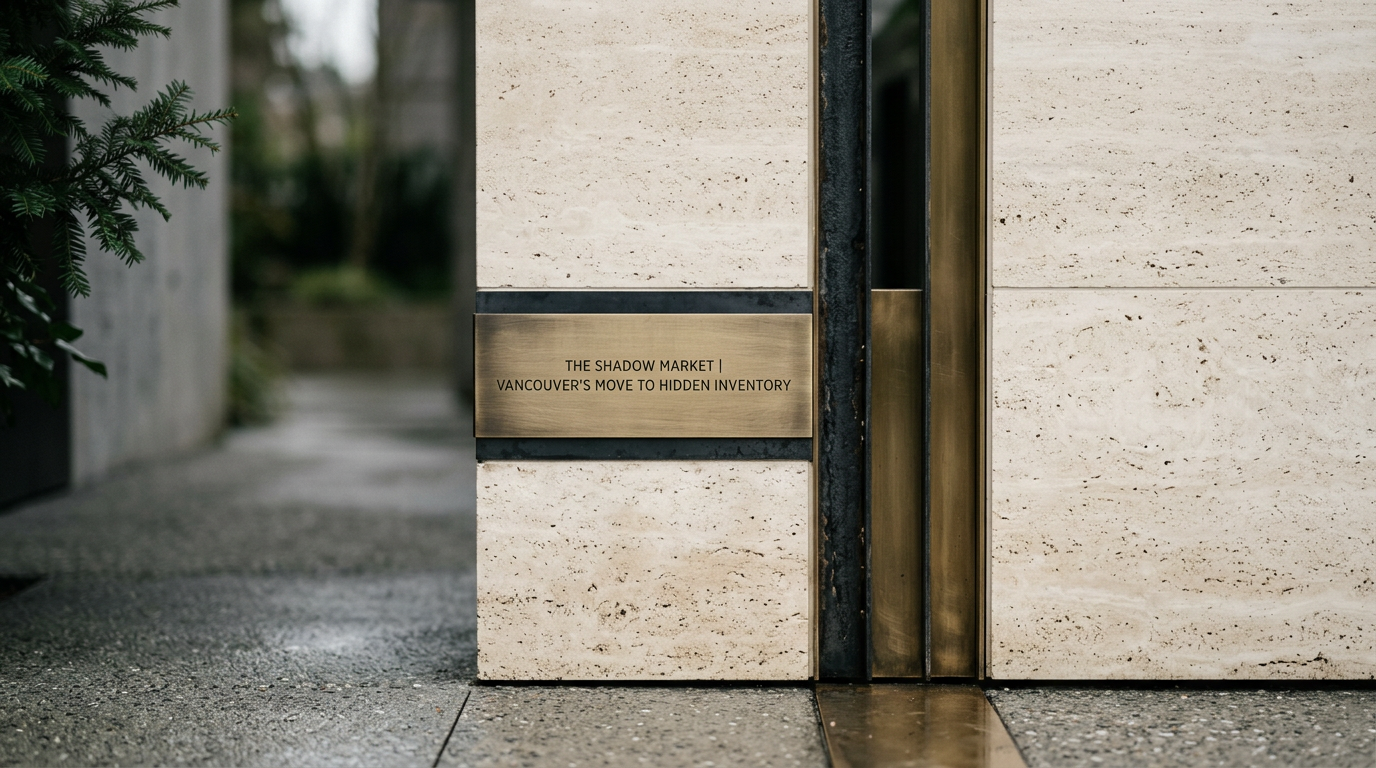
The Shadow Market: Vancouver’s Move to Hidden Inventory
Introduction
Vancouver’s ultra-prime market has entered a phase of strategic invisibility. Faced with an evolving landscape of speculation taxes and increased regulatory scrutiny, the city’s most coveted trophy assets are disappearing from public registries and entering a state of ‘institutional hibernation.‘
Core Driver: Regulatory Pressure & The Trust Pivot
The evolution of the Speculation and Vacancy Tax (SVT) and the Underused Housing Tax (UHT) has fundamentally altered the holding patterns of global capital. To mitigate tax exposure and avoid public scrutiny, UHNW investors are moving assets into complex private trusts and off-market holding structures. This has created a significant divergence between ‘listed’ inventory and ‘actual’ available inventory.
Investor Implications
The emergence of ‘Hidden Inventory’ means that the true benchmark for trophy asset pricing is no longer found in public sales data. We are seeing a bifurcation of the market: a public tier characterized by volatility and a private, off-market tier where assets are traded via curated networks, maintaining price floors regardless of broader market sentiment.
Actionable Strategy
For the alpha-seeking investor, the goal is to gain entry into the ‘private circuit.’ This requires leveraging institutional intermediaries who manage family offices and private trusts. The strategy is to identify ‘distressed’ trusts—where liquidity needs force a sale of a hidden asset—to acquire trophy properties at a discount to their true intrinsic value.
Conclusion
In Vancouver, the ultimate luxury is now anonymity. The market has pivoted from a display of wealth to a strategy of preservation, making the ‘shadow market’ the only place where true trophy assets are now traded.